Books I’ve Read in the Last Week

Books

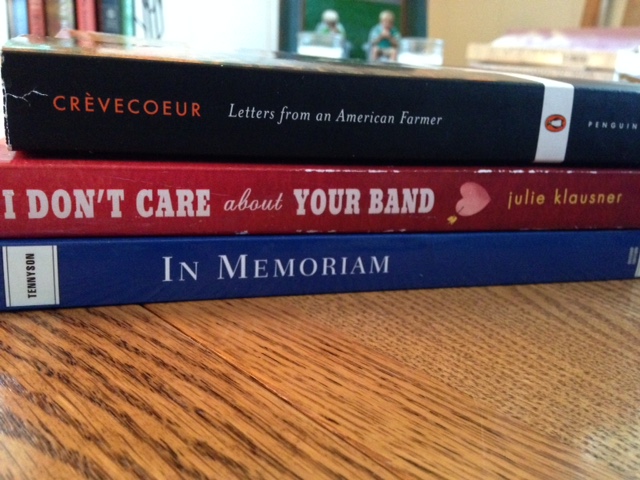
I’ve read three very different books in the last week for different reasons. The most important is In Memoriam because I have just returned from a family member’s funeral. The following lines have been meaningful to me as I think about the unnaturalness of death:

Thou madest man, he knows not why, / He thinks he was not made to die

Students’ Reading

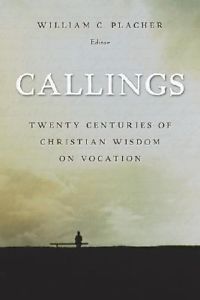
Callings cover

This semester I taught a course in the leadership minor called “Vocation Specific Leadership.” William C. Placher’s wonderful anthology Callings was one of our texts.

For the final exam, my students are putting two thinkers from the anthology in conversation with each other, and one student drew together two quotations in a particularly insightful way:

We do not obtain the most precious gifts by going in search of them, but by waiting for them. -Simone Weil

We must not imagine that we discover this destiny only by a game of hide-and-seek with Divine Providence. Our vocation is not a sphinx’s riddle which we must solve in one guess or else perish. -Thomas Merton

A Kiss of God

The Sabbath

In the introduction to Abraham Joshua Heschel’s book The Sabbath, his daughter Susannah Heschel writes of him:

On my father’s last Shabbat we had a wonderful dinner with many family friends, after which one of our guests read aloud some of my father’s Yiddish poems, written when he was a young man. He went to sleep that night and never woke. In Jewish tradition, dying in one’s sleep is called a kiss of God, and dying on the Sabbath is a gift that is merited by piety. For the pious person, my father once wrote, it is a privilege to die.

When Students Recite Poetry

This week and last week, the students in my British literature class memorized poetry. As I held office hours on the ground floor of Moody Library, I had the privilege to see many of them pacing Harvey Garden, poems in hand, preparing to recite some of the most brilliant expressions in the English language. Here are some of my favorite lines from the poems they selected:

What mighty contests rise from trivial things. -Alexander Pope, “The Rape of the Lock”

The also serve who only stand and wait.  -John Milton, “On His Blindness”

 What I do is me. -Gerard Manley Hopkins, “As Kingfishers Catch Fire”

 I have measured out my life with coffee spoons. -T.S. Eliot, “The Love Song of J. Alfred Prufrock”

ABL 1

Given that Baylor is home to the Armstrong Browning Library, I encouraged my students to memorize Elizabeth Barrett Browning’s sonnet, “How do I love thee? Let me count the ways,” and many of them did. These are my favorite lines from that poem:

I love thee with a passion put to use / In my old griefs, and with my childhood’s faith.

About halfway through the semester, we took a class trip to the Browning library, which holds the largest collection of Browning material. Since my dissertation focuses on American literature, I have not used the library for my own research; however, in my role as a Graduate Writing Consultant, I’ve become familiar with the library’s holdings, as I recently helped my friend and fellow Lilly Graduate Fellow, Karl, with his proposal to be a Teaching Fellow there this summer. This week, the announcement was released, and I was happy to see that he received the fellowship.

Thoreau’s “A Week”

Honors pic

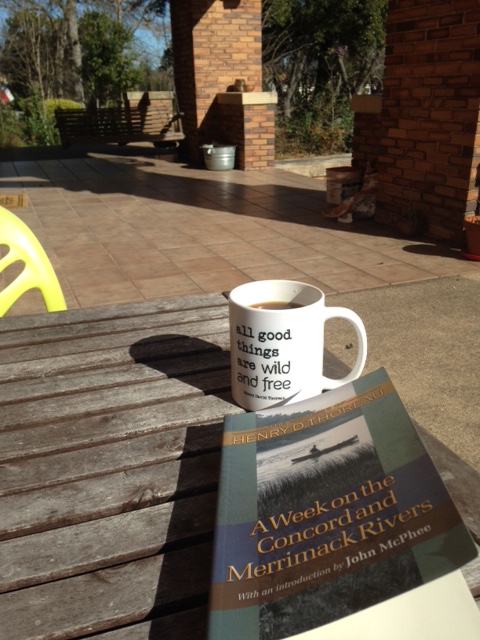
I’m getting ready to teach the “Sunday” section of Henry David Thoreau’s A Week on the Concord and Merrimack Rivers in an honors colloquium. Below are some passages I’m excited to discuss with my students.

There is in my nature, methinks, a singular yearning toward all wildness. (54)

Every people have gods to suit their circumstances. (65)

For six days shalt thou labor and do all thy knitting, but on the seventh, forsooth, thy reading. (66)

Tell me of the height of the mountains of the moon, or of the diameter of space, and I may believe you, but of the secret history of the Almighty, and I shall pronounce thee mad. (71)

There is no doubt that the loftiest written wisdom is either rhymed, or in some way musically measured,–is, in form as well as substance, poetry; and a volume which should contain the condensed wisdom of mankind, need not have one rhythmless line. (91)

He who resorts to the easy novel, because he is languid, does no better than if he took a nap. The front aspect of great thoughts can only be enjoyed by those who stand on the side whence they arrive. Books, not which afford us a cowering enjoyment, but in which each thought is of unusual daring; such as an idle man cannot read, and a timid one would not be entertained by, which even make us dangerous to existing institutions, –such I call good books. (96)

A perfectly healthy sentence, it is true, is extremely rare. (103)

The scholar may be sure that he writes the tougher truth for the calluses on his palms. They give firmness to the sentence. (106)

There is always room and occasion enough for a true book on any subject; as there is room for more light the brightest day and more rays will not interfere with the first. (109)
Sentences from Howards End

On Friday, I’ll finish Howards End with my British literature students. I’m planning a lesson that involves looking at several of Forster’s lovely,  often understated sentences:

One may as well begin with Helen’s letters to her sister. (5)

We never discuss anything at Howards End. (58)

But the proposal was not to rank among the world’s greatest love scenes. (119)

If Margaret wanted to jump from a motor-car, she jumped; if Tibby thought paddling would benefit his ankles, he paddled; if a clerk desired adventure, he took a walk in the dark. (156)

But he thought she was acting. He thought he was trapped. He saw his whole life crumbling. (166)

It was not true repentance. (175)

It was the crisis of his life. (217)

It was against all reason that he should be punished, but the law, being made in his image, sentenced him to three years’ imprisonment. Then Henry’s fortress gave way. (217)

The Pleasures of Reading

Since I’m in the last two weeks of the semester, I’ve returned to the below passage from Alan Jacobs’s The Pleasures of Reading in an Age of Distraction (2011), which reminds me why practicing perseverance in matters of the mind is so important.

Some forms of intellectual labor are worth the trouble. In those times when Whim isn’t quite enough, times that will come to us all, we discover this. Such work strengthens our minds, makes us more capable of concentration, teaches us patience—and almost certainly a touch of humility as well, as we struggle to navigate the difficult (if elegant) terrain of Hume’s prose. But what do we have more need for, in our whirling mental worlds, than strength and concentration and patience and humility? These are virtues worth aspiring to, especially because they lead to new and greater delights. (50)

Learning to Walk in the Dark

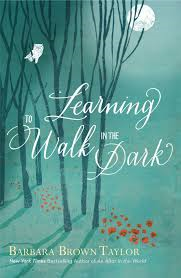
Last night, I finished Barbara Brown Taylor’s new book, which I found very thought-provoking. taylor

Here are a few of my favorite passages:

[W]hen, despite all my best efforts, the lights have gone off in my life (literally or figuratively, take your pick), plunging me into the kind of darkness that turns my knees to water, nonetheless I have not died. The monsters have not dragged me out of bed and taken me back to their lair. The witches have not turned me into a bat. Instead, I have learned things in the dark that I could never have learned in the light, things that have saved my life over and over again, so that there is really only one logical conclusion. I need darkness as much as I need light. (5)

Most of the books on the New York Times “How-To” bestseller list are about how to avoid various kinds of darkness. (5)

I learned that sadness does not sink a person; it is the energy a person spends trying to avoid sadness that does that. (80)

After years of being taught that the way to deal with painful emotions is to get rid of them, it can take a lot of reschooling to learn to sit with them instead, finding out from those who feel them what they have learned by sleeping in the wilderness that those who sleep in comfortable houses may never know. (86)

On the Road

From Jack Kerouac, On the  Road:

I woke up as the sun was reddening; and that was the one distinct time in my life, the strangest moment of all, when I didn’t know who I was—I was far away from home, haunted and tired with travel, in a cheap hotel room I’d never seen, hearing the hiss of steam outside, and the creak of the old woods of the hotel, and footsteps upstairs, and all the sad sounds, and I looked at the cracked high ceiling and really didn’t know who I was for about fifteen strange seconds. I wasn’t scared; I was just somebody else, some stranger, and my whole life was a haunted life, the life of a ghost. I was halfway across America, at the dividing line between the East of my youth and the West of my future, and maybe that’s why it happened right there and then, that strange red afternoon. (15)

My Heart Stirred for a Bird

On Monday, I taught four of Gerard Manley Hopkins’s poems in my British literature class: “God’s Grandeur,” “As Kingfishers Catch Fire,” “The Windhover,” and “Pied Beauty.” When we discussed “The Windhover,” I asked my students to pause over the following lines:

My heart in hiding / Stirred for a bird, –the achieve of; the mastery of the thing!

I then asked the students to consider whether they had ever had an experience such as the one Hopkins describes. My own experience of having my heart in hiding stir for something outside of myself involves the below image of Ruth and Naomi from the St. John’s Bible, which I saw when I was in Collegeville, MN in 2013.

Image from the Clark Library: http://wordpress.up.edu/library/saint-johns-bible/