Broad Questions in Education

Last weekend, I attended and presented at a conference on faith, teaching, and learning. It was enjoyable because I had the opportunity to consider and discuss the connection between classroom practices and broader issues like the purpose of college education. One of the speakers referenced some medieval images of the liberal arts such as the one below.

liberal arts

The Virtue of Self-Knowledge

I’m getting ready to present a paper, “Teaching Composition: Purgation and Self-Knowledge,” at the Kuyers Institute conference at Calvin College later this week. Below are some quotations I’ve included in my paper.

Now that the soul is clothed in these other garments of labor, dryness, and desolation, and its former lights have been darkened, it possesses more authentic lights in this most excellent and necessary virtue of self-knowledge.

-St. John of the Cross, The Dark Night

To know oneself is, above all, to know what one lacks. It is to measure oneself against Truth, and not the other way around. The first product of self-knowledge is humility.

-Flannery O’Connor, Mystery and Manners

To give oneself up in love, or dedication, one must have a self.

-Kathleen Norris, Amazing Grace

The Enlightenment and Self-Expression

I enjoyed reading John Wesley’s “The Case of Reason Impartially Considered” this week with my BIC students. I’m including a passage where he shares some of his personal experience regarding faith and reason because I think it demonstrates how Wesley uses enlightened rhetoric to examine the effects of the Enlightenment on Christianity.

It [reason] may present us with fair ideas; it can draw a fine picture of love: But this is only a painted fire. And farther than this reason cannot go. I made the trial for many years. I collected the finest hymns, prayers, and meditations which I could find in any language; and I said, sung, or read them over and over, with all possible seriousness and attention. But still I was like the bones in Ezekiel’s vision: “The skin covered them above; but there was no breath in them.”

Civil and Religious Freedom

I am getting ready to teach Phillis Wheatley in an honors colloquium, and I’m fascinated by the way she makes connections between civil, religious, and Enlightenment values in the below passage from her letter to Samson Occom.

[C]ivil and religious Liberty, which are so inseparably united, that there is little or no Enjoyment of one without the other: Otherwise, perhaps, the Israelites had been less solicitous for their Freedom from Egyptian Slavery […] for in every human Breast, God has implanted a Principle, which we call Love of Freedom; it is impatient of Oppression, and pants for Deliverance; and by Leave of our Modern Egyptians I will assert, that the same Principle lives in us.

wheatley

17th Century French Maxims

This week, I’ll be discussing 17th century French maxims by Francois de La Rouchefoucauld with my World Cultures class. Below are two of my favorites.

Love of justice in most men is only a fear of encountering injustice.

We confess to small faults to create the impression that we have no great ones.

Americans and Travel

I’m interested in the way Emerson and Thoreau portray the danger of travel or “leaving home” in the following passages.

The soul is no traveler: the wise man stays at home with the soul, and when his necessities, his duties, on any occasion call him from his house, or into foreign lands, he is at home still, and is not gadding abroad from himself. -Ralph Waldo Emerson, “Self-Reliance”

The road grew wilder and drearier and more faintly traced, and vanished at length, leaving him in the heart of the dark wilderness, still rushing onward with the instinct that guides mortal man to evil. -Nathaniel Hawthorne, “Young Goodman Brown”

Young-Goodman-Brown1

Haiku

I’m preparing a lesson on the Tokugawa dynasty (1600-1868) in Japan in my BIC class next week, and I like how the following haiku expresses a kind of sadness that accompanies new beginnings:

The first day of the year:

thoughts come–and there is loneliness;

the autumn dusk is here.

-Matsuo Basho

Hawthorne according to Orestes Brownson

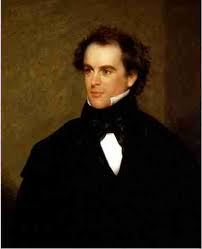
HawthorneRecently, I read the following from Orestes Brownson’s review of The Scarlet Letter in 1850. Although I think he misreads Hawthorne, I’m fascinated by his description of the link between humility and virtue.

Mr. Hawthorne seems never to have learned that pride is not only sin, but the root of all sin, and that humility is not only a virtue, but the root of all virtue. No genuine contrition or repentance ever springs from pride, and the sorrow for sin because it mortifies our pride, or lessens us in our own eyes, is nothing but the effect of pride. All true remorse, all genuine repentance springs from humility, and is sorrow for having offended God, not sorrow for having offended ourselves.

Dante Memoirs

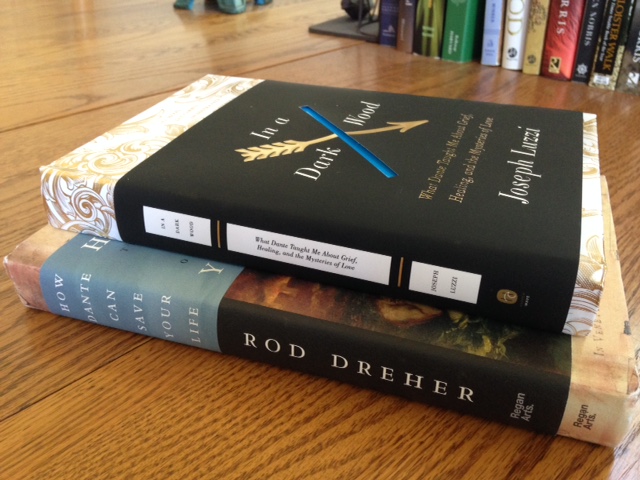
Dante books

In the past few months, I’ve read two memoirs about Dante: Rod Dreher’s How Dante Can Save Your Life, which was published in April, and Joseph Luzzi’s In a Dark Wood, just published in June. I’ve included a passage from each book, both of which appear near the end and speak to the way the authors make changes in their lives, with Dante’s help.

Love is not a contractual exchange; love is given with no expectation of return. Love does not keep a ledger. (290) -Dreher

I had imagined that fatherhood meant above all sacrifice, the giving up of the things you love for the one you love, a kind of ascetic affirmation of love in self-denial. How wrong I was. There was nothing of the sense of loss implied by sacrifice. The love I now felt for my daughter was the most satisfying, self-fulfilling I had ever known. In making her needs my own, I was finally able to let go of the searing loneliness and black hole of inwardness that had seized me since Katherine’s death. Loving and taking care of Isabel had rescued me from myself–it wasn’t sacrifice; it was sanctuary. (254-255) -Luzzi

The Throes of Dissertating

When I’ve not been traveling, I’ve spent most of my time this summer working on my dissertation. Today, I’ve been thinking about Simone Weil’s essay, “Reflections on the Right Use of School Studies with a View to the Love of God” as I push forward in this difficult task. Specifically, I appreciate the below passages because they speak to two difficulties of writing: acknowledging weakness and developing patience.

The second condition is to take great pains to examine squarely and to contemplate attentively and slowly each school task in which we have failed, seeing how unpleasing and second rate it is, without seeking any excuse or overlooking any mistake or any of our tutor’s corrections, trying to get down to the origin of each fault. There is a great temptation to do the opposite, to give a sideways glance at the corrected exercise if it is bad and to hide it forthwith. Most of us do this nearly always. We have to withstand this temptation. Incidentally, moreover, nothing is more necessary for academic success, because despite all our efforts, we work without making much progress when we refuse to give our attention to the faults we have made and our tutor’s corrections.

In every school exercise, there is a special way of waiting upon truth, setting our hearts upon it, yet not allowing ourselves to go out in search of it. There is a way of giving our attention to the data of a problem in geometry without trying to find the solution or to the words of a Latin or Greek text without trying to arrive at the meaning, a way of waiting, when we are writing, for the right word to come of itself at the end of our pen, while we merely reject all inadequate words.