Digital Humanities

Last month, I attended a Digital Humanities course at the University of Victoria. In the readings, I came across a phrase in an article by David M. Berry, the “digital intellect,” which has been very meaningful to me as I think about how to incorporate digital humanities into my teaching.

UVIC
University of Victoria

More Memoirs

Memoirs

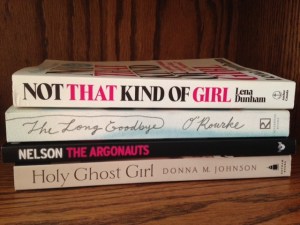
Recently, I’ve read the memoirs pictured. I especially enjoyed The Long Goodbye for what the author writes about C.S. Lewis and how his book, A Grief Observed, helped her as she encountered her mother’s death. This sentence follows her praise for Lewis:

The literature of mourning enacts that dilemma; its solace lies in the ritual of remembering the dead and then saying, There is no solace, and also, This has been going on a long time. (126)

Echoes of Franklin and Aristotle

I finished reading Hannah Webster Foster’s The Boarding School (1798), and I like to see the influence of both Aristotle and Franklin on her thinking, evident in the following passages:

[T]he foundation of a useful and happy life must be laid in youth, and that much depends on the early infusion of virtuous principles into the docile mind.

We ought never to be idle. No moment should be unoccupied. Some employment, salutary, either to body or mind, or both, should be constantly pursued.


Academic Conference

Stowe


Last week, I traveled to Vermont for a Hawthorne conference, and I’ve been thinking about the following excerpt from Augustine’s Confessions, which I quoted in my presentation:

[T]here can also be in the mind itself, through those same bodily senses, a certain vain desire and curiosity, not of taking delight in the body, but of making experiments with the body’s aid, and cloaked under the name of learning and knowledge.

More Reading Memoirs

I finished two more reading memoirs recently, Lynne Sharon Schwartz’s Ruined by Reading (1996) and Pat Conroy’s My Reading Life (2010). Here are a couple passages I liked that depict the life of the reader/writer:

There was life before reading. Not until the sixteenth century were manuscripts even available, except to monks and royalty. What could it have been like? -Schwartz

Good writing is the hardest form of thinking. -Conroy

The Interiority of Sin

Austin

At the workshop this week, we also discussed the first chapter of James Baldwin’s Notes of a Native Son, and I have been thinking about the following sentence, which shows that human sin is ultimately internal:

This fight begins, however, in the heart and it now had been laid to my charge to keep my own heart free of hatred and despair. (114)

The Size of the Decision

This week, I’m attending a women’s writing workshop on the memoir at a seminary in Austin, and one of the reading assignments is Jeanette Winterson’s Why Be Happy When You Could Be Normal? I like the quotation I’ve included below, which speaks to taking risks.

I have noticed that doing the sensible thing is only a good idea when the decision is quite small. For the life-changing things, you must risk it. (63)

Advice about the teaching life

I read Jay Parini’s The Art of Teaching, and here are my favorite passages:

The main lesson I learned from this important teacher was that content matters more than anything else. You cannot fake the substance of a course, and must always teach from the center of your material, trusting the material to carry the class forward, to stimulate the students. (23)

Be willing to take risks, in your conversations with colleagues and students, in your writing and research. No good will come of shyness, laziness, timidity. (116)

It does not advance a student’s intellectual progress to offer lame praise and avoid the problems at hand. (121)

Book Club Reading

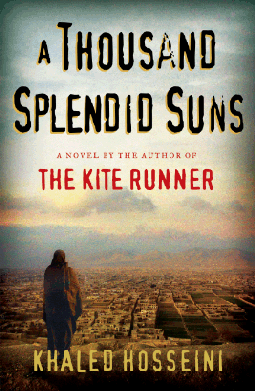
Earlier this week, I read A Thousand Splendid Suns in order to participate in a book club. I loved the story, though it was incredibly sad. Below are a few passages I thought were moving.

You see, I knew your mother before you were born, when she was a little girl, and I tell you that she was unhappy then. The seed for what she did was planted long ago, I’m afraid. (43)

Laila had watched Mammy come undone that day and it had scared her, but she hadn’t felt any true sorrow. She hadn’t understood the awfulness of her mother’s loss. Now another stranger bringing news of another death. Now she was the one sitting on the chair. Was this her penalty, then, her punishment for being aloof to her own mother’s suffering? (210)

Though there had been moments of beauty in it, Mariam knew that life for the most part had been unkind to her. But as she walked the final twenty paces, she could not help but wish for more of it. (370)

Books about Books

I love to peruse what is often called the “reading memoir,” and so I just finished David Shields’s How Literature Saved My Life (2013). Shields and I have not been impacted by many of the same books (what I hoped to find in his book), and so my favorite part of his was the following story that illustrates the temperament of the reader-writer:

When I was a little kid, I was a very good baseball player, but I mostly preferred to go over to the park across from our house, sit atop the hill, and watch Little Leaguers, kids my age or younger, play for hours. “What’s the matter with you? my father would ask me. “You should be out there playing. You shouldn’t be watching.” I don’t know what’s the matter with me–why I’m so adept at distance, why I feel so remote from things, why life feels like a rumor–but playing has somehow always struck me as a fantastically unfulfilling activity. (4-5)