I read Shusaku Endo’s Silence while I was sitting in airports over the weekend. I absolutely loved the introspective nature of the book, though I was devastated by the story.

I read Shusaku Endo’s Silence while I was sitting in airports over the weekend. I absolutely loved the introspective nature of the book, though I was devastated by the story.
I taught Emerson this week, which I always enjoy. This time, it was fun to see my students interact with some of Emerson’s more surprising statements in “Self-Reliance”:
A great man is coming to eat at my house. I do not wish to please him: I wish that he should wish to please me.
Friend, client, child, sickness, fear, want, charity, all knock at once at thy closet door and say, ‘Come out unto us.’–Do not spill thy soul; do not all descend; keep thy state; stay at home in thine own heaven.

The Reader by Pierre Auguste Renoir (1876)
Today I read William Ellery Channing’s 1826 essay, “Remarks on the Character and Writings of John Milton,” and I found the following passage humorous because it expresses the long competition between humanities and the sciences. He writes that poetry is important because
It is needed to counteract the tendency of physical science, which, being now sought, not, as formerly, for intellectual gratification, but for multiplying bodily comforts, requires a new development of imagination, taste, and poetry, to preserve men from sinking into an earthly, material, Epicurean life. (499)
I came across this quotation in my reading recently, which I appreciate for its representation of the close relationship between virtue and vice:
A cardinal American virtue, “ambition,” promotes a cardinal American vice, “deviant behavior.” -Robert K. Merton
I’ve been reading Little Women, which I will also teach this fall. I love the following statement Meg makes when, on her wedding day, she neither walks down the aisle nor stays hidden till the beginning of the wedding:
“I’m not a show” (200, Norton Critical Edition)

I’ve been reading one of my favorite books in preparation to teach it this fall! I love this short dialogue about the boy’s hopeful perspective:
Maybe he believes in God.
I dont know what he believes in.
He’ll get over it.
No he wont. (174)
I decided to read John Knowles’s A Separate Peace because I read it in high school but didn’t remember much of the story. After having read The Things They Carried, I was interested in how a father advises a couple of young men before they go off to WWII, which reveals a much more idealistic and simplistic view of war than O’Brien’s book:
You have to do what you think is the right thing, but just make sure it’s the right thing in the long run, and not just for the moment. Your war memories will be with you forever, you’ll be asked about them thousands of times after the war is over. (199)
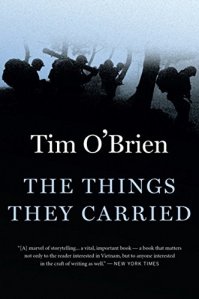
I finished The Things They Carried over the weekend, and I’ve been thinking about how O’Brien describes courage in the following passage:
Sometimes the bravest thing on earth was to sit through the night and feel the cold in your bones. Courage was not always a matter of yes or no. Sometimes it came in degrees […] In certain situations you could do incredible things, you could advance toward enemy fire, but in other situations, which were not nearly so bad, you had trouble keeping your eyes open. Sometimes, like that night in the shit field, the difference between courage and cowardice was something small and stupid. (147)
I didn’t have a chance to read Tim O’Brien’s Vietnam memoir, The Things They Carried, before he came to Baylor earlier this year, so I’m reading it now. I’ve included a few passages that express the workings of memory, particularly as it relates to tragedy and trauma:
The bad stuff never stops happening: it lives in its own dimension, replaying itself over and over. (32)
In a way, I guess, she’s right: I should forget it. But the thing about remembering is that you don’t forget. (34)
Stories are for joining the past to the future. Stories are for those late hours in the night when you can’t remember how you got from where you were to where you are. (38)
 Rachel B. Griffis