Heathcliff and Thinking

Recently I read Wuthering Heights, which I hadn’t read since high school and barely remembered. I was struck by the following expression from Heathcliff regarding how he copes with pain. (And I think the book cover below is fantastic–one of the Penguin Classics editions, which I love.)

Let me alone, and I’ll plan it out: while I’m thinking of that, I don’t feel pain. (62)

Wuthering Heights


“The Woods” in Literature

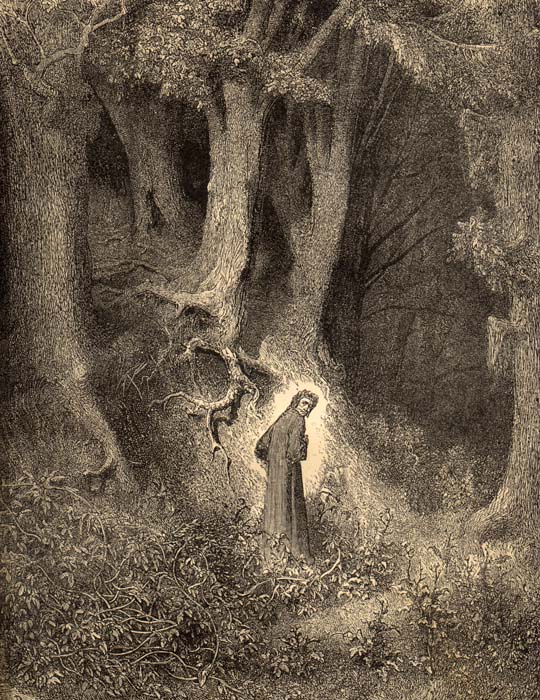
Today I was considering how two of my favorite literary works have very different depictions of the woods:

Midway in our life’s journey, I went astray / from the straight road and woke to find myself / alone in a dark wood. -Dante

I went to the woods because I wished to live deliberately, to front only the essential facts of life, and see if I could not learn what it had to teach, and not, when I came to die, discover that I had not lived. -Thoreau

Dante's woods

Reading about Reading

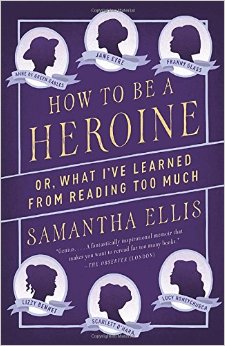
heroine coverI read this memoir about reading earlier in the week. I’ve included some passages that speak to the perils and delights of reading.

My reading has sometimes got me into trouble. (5)

And even then, I wanted to live a storybook life. (9)

She was my first heroine. I thought her life was high romance. My mother did not. She wanted to shield me from suffering, she wanted me never to have to go through what she’d gone through; she wanted me to have a boring life. Throughout my childhood, this outraged me. Never to have adventures? Never to do extraordinary things? Never to take risks? When I once wished aloud that I could go to prison because at least it would be interesting, my mother shuddered. (9-10)

If only I’d spent my twenties trying to be more like Neely than Anne. If only I’d read other books. (175)

A 19th century Unitarian Minister on Suffering

I came across this wonderful passage on the nature of suffering in Sedgwick’s Married or Single? (1857) while reading for my dissertation. It’s from a Unitarian minister, writing in 1853.

Have you, reader, ever experienced a great sorrow? and if so, have you not seen afterward how it discloses heights and depths in your spiritual nature which you had never known, and resources upon which you had never drawn; how it produces susceptibilities which you had never before felt; how it induces a tenderness of mind that makes it ductile almost as the clay, and ready to receive the stamp of the divine image; how little animosities and hatreds are banished and forgotten, while the heart has new yearnings toward all that live, and especially toward all that suffer; how the soul sickens at mere shows and appearances, and demands realities, while it hungers after the good and the true; how this world recedes less, while the world of immortality comes on as if now first revealed, and incloses you in its light, just as when the glare of the day is withdrawn and the darkness moves over us, we gaze on a new sky, and bathe in the starry splendors of the milky way.

-Edmund H. Sear, Regeneration

Poetry for Grief, Part III

When grief comes to you as a purple gorilla

you must count yourself lucky.

You must offer her what’s left

of your dinner, the book you were trying to finish

you must put aside

and make her a place to sit at the foot of your bed,

her eyes moving from the clock

to the television and back again.

            -from Matthew Dickman, “Grief”

Thoreau’s birthday

In honor of Thoreau’s birthday, 198 years ago, I’ve included some of my favorite quotations from Walden.

The mass of men lead lives of quiet desperation.

If I knew for a certainty that a man was coming to my house with the conscious design of doing me good, I should run for my life.

Simplify. Simplify.

Walden Pond, when I visited in 2012

Intellectual Freedom and Change

LinwoodsRecently, I reread Catharine Sedgwick’s historical novel about the Revolutionary War, The Linwoods (1835), a book I address in my dissertation. I’m including a passage below that interests me because the author links the ability to change one’s beliefs and opinions with intellectual freedom. The passage is a bit of dialogue, Eliot Lee speaking to Isabella Linwood.

I have seen your mind casting off the shackles of early prejudices, resisting the authority of opinion, self-rectified, and forming its independent judgments on those great interests in which the honour and prosperity of your country are involved. I have gloried in seeing you willing to sacrifice the pride, the exclusiveness, and all the little idol vanities of accidental distinctions, to the popular and generous side. (322)

Sin, Vice, Evil

glittering vices

After spending a week studying Dante last month, I’ve been inspired to read more about sin, so I read Rebecca Konyndyk DeYoung’s book about the seven deadly sins. I’ve included some passages I found helpful and meaningful.

When our character is distorted by vice, we seek these goods—and they are genuinely good things—in a misguided or even idolatrous manner: in the wrong way, at the wrong times and wrong places, too intensely, or at the expense of other things of greater value. That’s what makes the vices evil. (39)

Vainglory is a cheap substitute for true fulfillment of the human desire to be profoundly known by another person—to be known by name, for who one truly is—and to be loved just that way. […] A life spent praising ourselves, or seeking our own praise, will thereby stunt our growth and flourishing as human beings.  (74)

In sloth, we are literally divided against ourselves. We were made for relationship with God. If we are slothful, we have chosen to reject that relationship as the way to find fulfillment and chosen to try to make something else do its work instead. We are trying to make ourselves content with being less than we really are. (89)

Courage is the virtue of handling fear well; someone with courage fears the right things, in the right way, and at the right time. (148)

When we misuse something habitually, we find we lose our ability to appreciate its true goodness. (168)